Web Calendar - Modern Web Application specifics
back to login page
back to details of Automation used
back to details of SOAP Web Services Integration implemented
back to details of Continuous Integration and Continuous Deployment (CI/CD) using 'onprem and cloud Jenkins ' implemented
to details of Azure hosted scalable microservice based setup of this site
Table of Contents1. SCALABLE CLOUD HOSTED DB - COSMOS NOSQL 2. SPRING BOOT MICROSERVICE FOR DB CRUD OPERATIONS 3. CLOUD HOSTED SPRING BOOT FRONTEND 4. HOW DOES IT INTEGRATE 5. FUTURE: CI / CD WITH GITHUB ACTIONS FOR WEB CALENDAR APPLICATION 6. REFERENCES Back to Top |
1. SCALABLE CLOUD HOSTED DB - COSMOS NOSQLCosmos SQL Database is a web scalable database, in my case hosted in Azure. When we need to scale upwards, with traditional SQL databases, we have to bump up the server RAM/CPU or manage data across servers painstakingly. With Azure Cosmos No SQL db, it is a distributed database and can easily be split apart across multiple data centers, making it highly scalable. The 'NoSQL' nature means that we can continue to use SQL queries to manage it. It manages this via maintaining a Partition id for each record. More later. 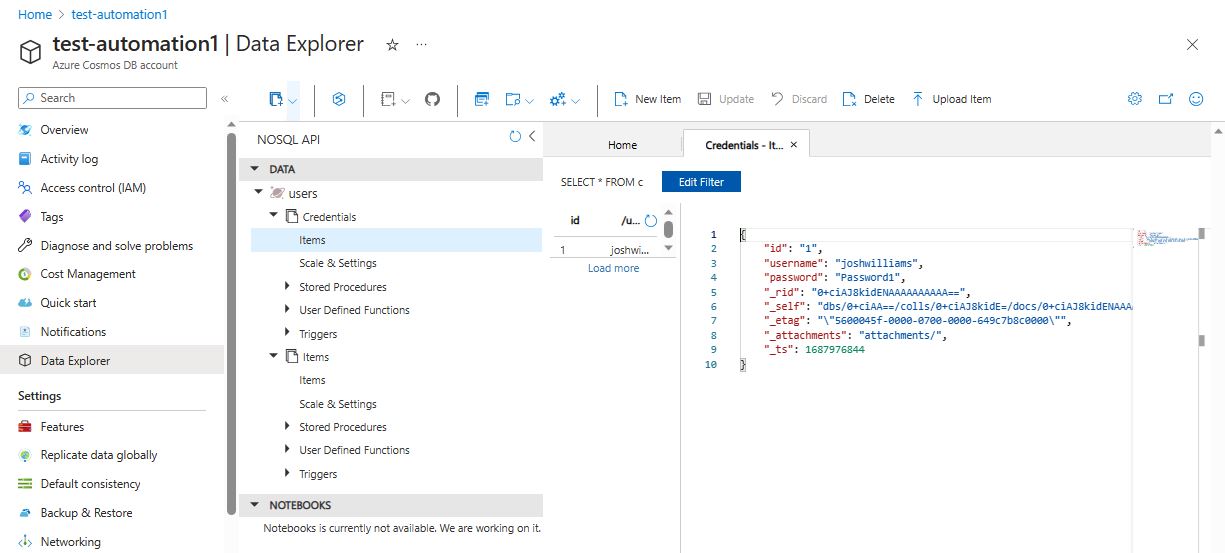
Back to Table Of Contents |
2. SPRING BOOT MICROSERVICE FOR DB CRUD OPERATIONSTo reduce risk and improve usability an application with an api interface sits infront of Web Calendar's Cosmos DB. This is also hosted in the cloud. Below is a screenshot of its API interface being tested with Postman API tool. 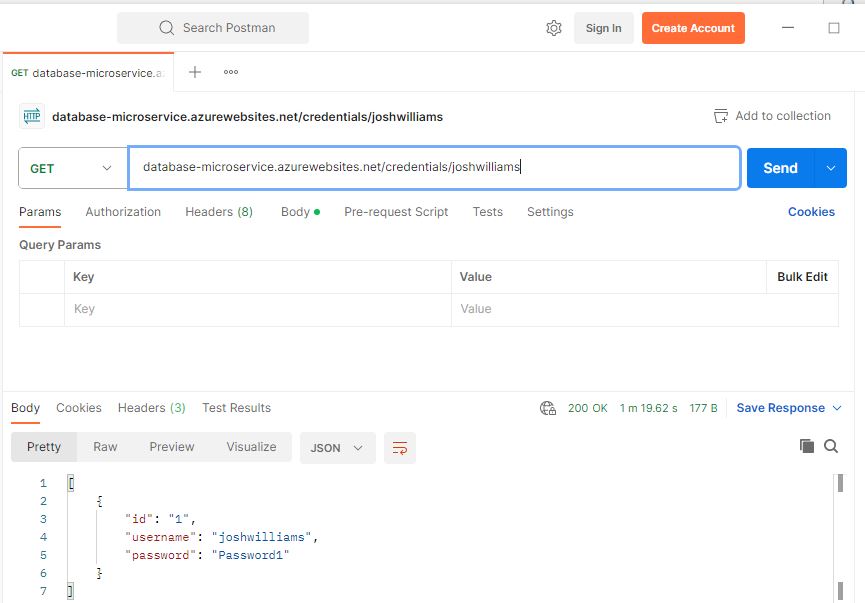
Back to Table Of Contents |
3. CLOUD HOSTED SPRING BOOT FRONTENDAs you can see from the url, this is a spring boot site hosted on Azure Cloud. Entire application is hosted entirely on cloud and code is in Git hub. Next step is to setup CI/CD with 'Github actions'! HOW WAS APP DEPLOYED TO AZURE? This was done via native functionality in VS Code IDE. Log into azure portal with your paid/trial account. In your spring boot application in VS code, under the 'targets' folder, there is a .jar/.war file. Right click it and select 'deploy to web app..' option. Follow prompts and it should deploy as shown below: 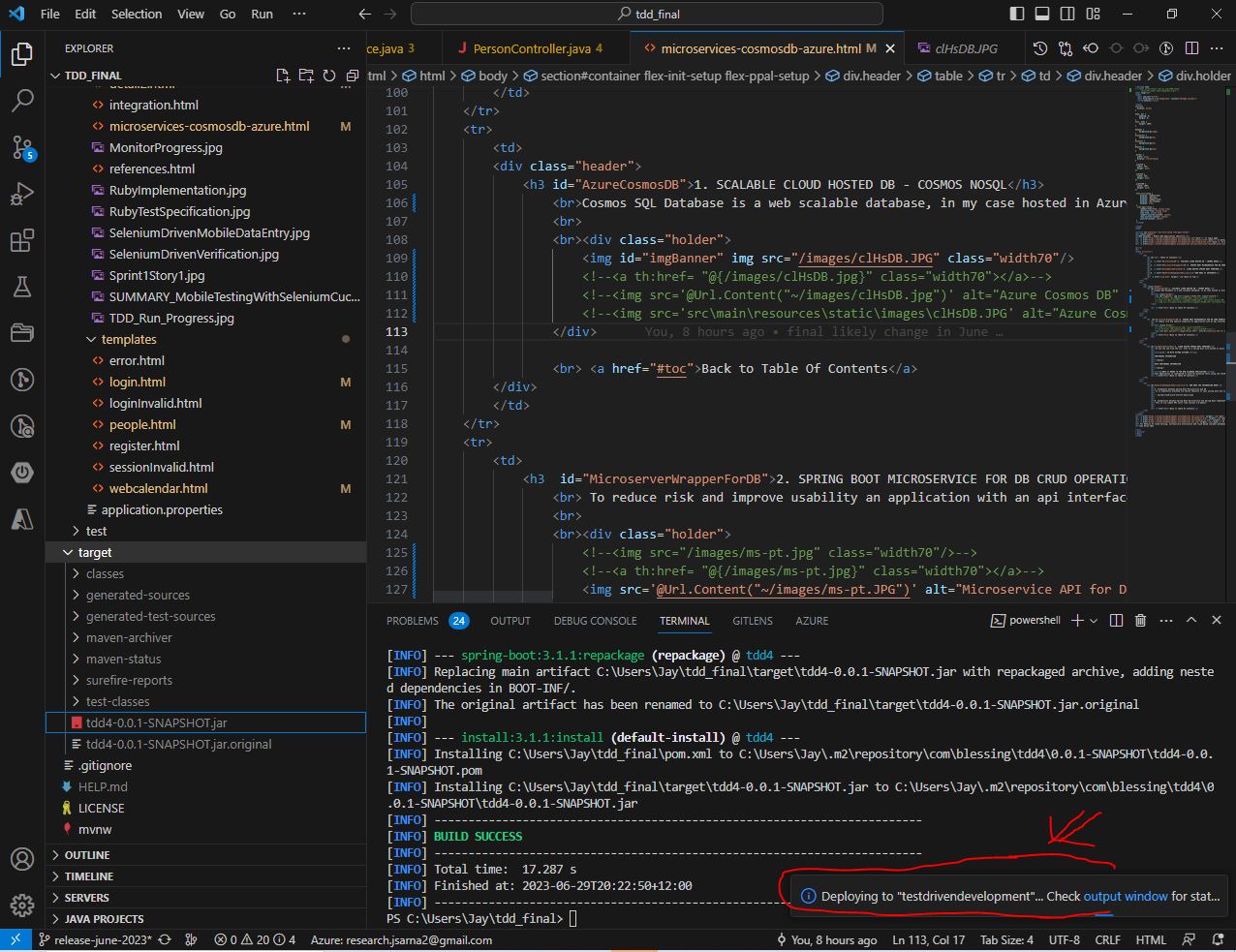
|
4. HOW DOES THE INTEGRATION WORKA. Integraton between Spring Boot Microservice and DB It is seamlessly achieved via native features of java spring boot due to maven dependency called: - spring-cloud-azure-starter-data-cosmo B. Integration between Spring Boot Microservice and Spring Boot Thymeleaf based front end This is via simple API calls (see section 2.0 above). Back to Table Of Contents |
5. FUTURE: CI / CD WITH GITHUB ACTIONS FOR WEB CALENDAR APPLICATIONEND GOAL - DEVSECOPS - CONTINUOUS INTEGRATION/ CONTINOUS DEPLOYMENT (CI/CD) WITH BUILT IN SECURITY PLAN TO ACHIEVE Development Security Operations (DEVSECOPS) Paradigm via this exercise DevOps is about integrating Development (includes 'quality assurance'/testing) and Operations in one seamless process with a focus on automation to make the process efficient as it is a lot of work if done manually (as in the past). It does that via CI/CD pipelines and agile processes for software development (see Agile Manifesto e.g. 'Responding to change over following a plan'. DevSecOps is a recent pradigm shift to that and is the future of IT. It is a system where security is inbuilt in every step of development and deployment/operations. Continous monitoring (e.g. via code/automation following is setup - automated vulnerability scanning on nuget packages, alerts on availability cloud Infrastructure) in addtion to Devops automated testing provides continous and automated compliance enforcement[33]. This helps with maintaining 'Zero Trust', where there is an assumption that malicius users can be anywhere and have access to our systems already, so our job is to limit the damage. DevSecOps pillars are Develop, Build, Test, Release & Deploy, and Runtime aimed at achieving a secure posture with the focus being on automation and integration going forward [32], inorder to make the process sustainable. 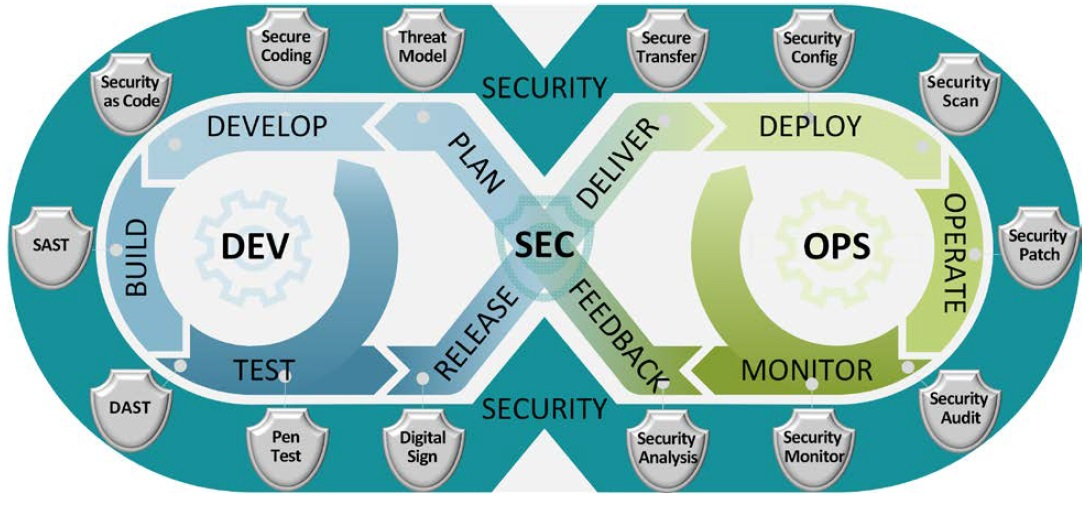
This was achieved with Jenkins previously in 2016 (see link in footer for CI/CD). The objective is now to do that with the latest technology, particulary the cloud. Now our infrastructure is also in the cloud, so we provision that with our application via YAML pipelines. BICEP is Microsoft recommeneded language to provision infrastructure in Cloud (Infrastructure as Service). So, if I was to port this application to use CI/CD pipelines for cloud, I would first provision the infrastructure in Azure using BICEP via yaml pipelines (e.g. WebApp to host application and keyVault to store secrets). in Git hub actions with secrets in Azure Key Vault. I would then use the same pipleline to build the application code and deploy it in Azure. A part of this would also be to run my test automation suite. All this would happen via a click of a button and this would be a CI/CD pipeline. I will also do some automated vulnerability scanning as part of deployment and use containers. The reason is to include some Security aspects to my devops setup. Together, this would be a basic DevSecOps pipeline. I have done similar work before but I now plan to do this via free software in Git Hub actions. Please watch this space. WITH CONTINUOUS INTEGRATION --coming-- WHAT IT MEANS TO THE WEB CALENDAR APPLICATION In 2016, this application was configured to auto-run Selenium tests using the TestNG framework right after the application build is triggered in Jenkins to enable instant Quality feedback. At the end of my exercise, it will be on the first ladder of cloud based DevSecOps. Back to Table Of Contents |
6. REFERENCES (proper APA style is on the way e.g. see id# 24)
Note: All the work done in 2023 on this website (everything on this page) was done using the help from these websites:
1. Working with application servers in Visual Studio Code. Source: https://code.visualstudio.com/docs/java/java-tomcat-jetty
2. Spring Boot support in Visual Studio Code. Source: https://code.visualstudio.com/docs/java/java-spring-boot
3. Getting Started with Java in Visual Studio Code. Source: https://code.visualstudio.com/docs/java/java-tutorial
4. Create First Microservice using Spring Boot | by Maneesha Indrachapa | Dev Genius. Source: https://blog.devgenius.io/create-first-microservice-using-spring-boot-1994cd78bbdf#:~:text=Create%20First%20Microservice%20using%20Spring%20Boot%201%201.,Creating%20Controllers%20...%206%206.%20Testing%20the%20APIs
5. Build and Deploy Java Web Apps to the cloud with Visual Studio Code. Source: https://code.visualstudio.com/docs/java/java-webapp
6. Docker extension for Visual Studio Code. Source: https://code.visualstudio.com/docs/containers/overview
7. Java project management in Visual Studio Code. Source: https://code.visualstudio.com/docs/java/java-project
8. Spring Boot support in Visual Studio Code. Source: https://code.visualstudio.com/docs/java/java-spring-boot
9. How do I find where Java is installed on Windows 10? - Stack Overflow. Source: https://stackoverflow.com/questions/69990781/how-do-i-find-where-java-is-installed-on-windows-10
10. How to Run Spring Boot Application? - GeeksforGeeks. Source: https://www.geeksforgeeks.org/how-to-run-spring-boot-application/
11. How to use Azure Cosmos DB from your Spring Boot App - Episode 48 - YouTube. Source: https://www.youtube.com/watch?v=4fSvyQw6luE
12. https://stackoverflow.com/questions/30855864/maven-no-plugin-found-for-prefix-spring-boot-in-the-current-project-and-in-th
13. https://learn.microsoft.com/en-us/azure/developer/java/spring-framework/configure-spring-boot-starter-java-app-with-cosmos-db
14. https://stackoverflow.com/questions/51221777/failed-to-configure-a-datasource-url-attribute-is-not-specified-and-no-embedd
15. terminal - How to push a new branch in git? - Stack Overflow. Source: https://stackoverflow.com/questions/52231262/how-to-push-a-new-branch-in-git
16. How to create a Servlet application in vs code - https://youtu.be/A939OhSK6Kg
17. How to setup Apache Tomcat, create War file and deployment in tomcat - https://youtu.be/CqSW7T2-E1Q
18. How to deploy a jsp application to Azure Web app via ftp - https://youtu.be/V01GwRMCk2s
19. java - Tomcat 7.0.43 "INFO: Error parsing HTTP request header" - Stack Overflow. Source: https://stackoverflow.com/questions/18819180/tomcat-7-0-43-info-error-parsing-http-request-header
20. Run and Debug Java Web Application in Tomcat using VS Code | Use VS Code Community Server Connector - YouTube. Source: https://www.youtube.com/watch?v=RiPot1ne8rI
21. Git-How to manage upstream branches - How To Set Upstream Branch on Git – devconnected. Source: https://devconnected.com/how-to-set-upstream-branch-on-git/
22. servlets - java.lang.ClassNotFoundException: HelloServlet at org.apache.catalina.loader.WebappClassLoader.loadClass - Stack Overflow. Source: https://stackoverflow.com/questions/10380782/java-lang-classnotfoundexception-helloservlet-at-org-apache-catalina-loader-web
23. Spring Boot and Beans ! 🍃. Spring boot is one of the most widely… | by Yogesh Ananda Nikam | Geek Culture | Medium. Source: https://medium.com/geekculture/spring-boot-and-beans-b2797b488fde
24. Foster, K.(2021). Spring Boot & Thymeleaf Tutorial (+ Bootstrap). Source: https://www.youtube.com/watch?v=KTBWCJPKiqk
25. WriteCodeWith prince.(2021). Registration Form Spring Boot with MySQL Database. Source: https://www.youtube.com/watch?v=RA6H-fECoKg
26. https://stackoverflow.com/questions/60431441/redirect-to-post-method-in-same-controller
27. https://stackoverflow.com/questions/14470111/spring-redirectattributes-addattribute-vs-addflashattribute
28. git - Connect a local repository with a remote repository - Stack Overflow. Source: https://stackoverflow.com/questions/11188801/connect-a-local-repository-with-a-remote-repository#:~:text=do%20the%20following%20steps%3A%20cd%20existingLocalRepo%20git%20remote,upload%2Fpush%20your%20local%20branches%20to%20the%20remote%20repo
29. View the recent commit history in Git | Reactgo
30. Git commands from Java using JGIT | Programmatically git clone, checkout -b, commit -a, log, status, branch - Its All Binary - Coding Posts, Examples, Projects & More
31. Add Comments to Website (quackit.com)
32. United States (US) Government's Department of Defence (DOD).(2023). DOCS Mission - Guidelines for partners to maintain complaince. Source: https://public.cyber.mil/devsecops/
33. Sharma, S.(2012). AGILE DEVELOPMENT, DEVOPS: Understanding DevOps – Part 4: Continuous Testing and Continuous Monitoring. Source: https://sdarchitect.blog/2012/10/30/understanding-devops-part-4-continuous-testing-and-continuous-monitoring/
back to Top of Page
back to details of Automation used
back to details of SOAP Web Services Integration
back to login page
For details of Cloud hosting, microservice utilisation and cloud based scalable database use, click here
For details of Continuous Integration and Continuous Deployment (CI/CD) using 'onprem and cloud Jenkins ' implemented, please click here
�Jay Sarna 2023